Continuing Education Credits for Massage Therapists Now Available from Essential Somatics

I’m proud to announce that I am now an “Approved Provider” of continuing education credits for the National Approved Provider Logo final pathsCertification Board for Therapeutic Massage & Bodywork (NCBTMB). The following courses are now approved for continuing education credits:

Somatic Exercise Coach Training – Level One – 24 CE credits

The Fundamentals of Hanna Somatic Education – 8 CE credits

These courses will teach you the basic principles, science and assessment techniques underpinning what many in the medical profession are calling the “missing link in medical care.” Because Hanna Somatics addresses muscle tension and pain at the level of the central nervous system, pain relief is more long lasting.

How many of you are frustrated with working on a client whose shoulders (or neck, hip, back) won’t relax no matter what you do? How many of you aren’t sure how to help someone with major postural imbalances? How many of you are exhausted by working too hard to relax your client’s muscles – to the point of compromising your own posture and well-being? These courses will teach you information you can use for yourself and your clients, in order to learn to reverse your own muscle pain – on your own.

The mystery of most chronic muscle pain isn’t mysterious.

The fundamentals and basic Somatic Exercises of Hanna Somatic (Clinical Somatic) Education will de-mystify much of the mystery of chronic muscle pain and help you begin to help your clients more effectively. You will learn:

  • How to recognize the three stress reflexes (as described by Thomas Hanna in the book, Somatics) to better understand and assess your client’s muscular imbalances.
  • The root cause of chronic muscle pain – Sensory Motor Amnesia – and how it presents itself as, for example, low back pain, sciatica, TMJ, plantarfascitis, piriformis syndrome, neck, shoulder and hip pain.
  • How re-educating muscles through movement, is the best way to reverse muscle tension and pain and improve muscle function – for the long term.
  • How pandiculation, rather than stretching (whether static or active isolated) is the most rapid and effective way to re-set muscle length, function and tonus.
  • How to teach your clients gentle, easy, profoundly effective somatic exercises that will release muscles faster and more effectively than passive stretching techniques.
  • Self care exercises that will help you reverse your own muscle pain so you can continue to move well and work for as long as you wish.

I have been practicing somatic movement for several months with good results, but having had a one to one session with Martha’ s careful and precise guidance, I feel I gained an extra dimension to my overall movement quality. After just a 1-hour session my posture changed, my shoulders were more level and my gait was lighter and more fluid.

I give somatic exercises to most of my patients and I would encourage anyone interested in health to explore the potential of Hanna Somatics, either in a private session, a group workshop or through the DVDs available.

Dr. Andrea Franzi, Oseopath, York, England

Martha Peterson is the author of the book, Move Without Pain and developer of the “Pain-Free” series of instructional Somatic Exercise DVDs. Click here for her full bio.

Martha graduated from the National Holistic Institute in Oakland, CA. in 1988. In 2006 she graduated from the Somatic Systems Institute in Northampton, MA and was certified by the Novato Institute in Novato, CA as a Certified Hanna Somatic Educator. She teaches workshops, clinical trainings and private clinical sessions in both the USA and internationally. Contact her directly if you would like to bring her to your area for a training or workshop.


Move More, Get Stronger and Live Longer

My clients often ask me, “now that I’m no longer in pain, what kind of exercise should I do so I don’t hurt myself again?” My answer usually goes like this:

Exercise is fun and good for you, so have at it! Once you’ve reversed your Sensory Motor Amnesia, it’s imagesimportant to integrate your new awareness and control into full body movement.  It’s also important to strengthen the new, more balanced posture and movement.

Do what you love to do now that you have awareness and control of your body and movement.  Just pay attention! Paying attention and moving within your comfort range is what will help you prevent injury. Challenge yourself, yet be mindful not to go beyond what truly feels good just because you think it’s going to make you healthy. 

On page 30 of my book, Move Without Pain, I write about walking, one of the most basic, fundamental activities in the human vocabulary. I write about movement, rather than exercise being the key to long term health. Create a movement-filled life and you’ll generally find your health and fitness to be better than you  realize.

Gretchen Reynolds, author of the book, The First 20 Minutes: Surprising Science Reveals How We Can Exercise Better, Train Smarter, Live Longer, share a similar outlook (as discussed in a May 2012 New York Times article).

She says,

I wanted people to understand…how little exercise you can do in order to get lots and lots of health benefits. Two-thirds of Americans get no exercise at all. If one of those people gets up and moves around for 20 minutes, they are going to get a huge number of health benefits, and everything beyond that 20 minutes is, to some degree, gravy.

Those who know me have heard me mention my mother, Meg Peterson, as an example of one whose movement-IMG_0058filled life has kept her strong, fit and, at the age of 85, still hiking. Yes, she was blessed with good genes, but more importantly, she refused to slow down as she got older. She takes out her own trash, mows her own lawn, walks several miles daily (and incorporates hills when possible) and doesn’t shy away from using the stairs instead of an elevator. And yes…she does her Somatics!

Now, you don’t have to hike in the Himalayas (as in the photo of my mother and me at right) in order to be fit and healthy.

  • walk instead of using the car
  • pick up the laundry basket and take it upstairs
  • garden
  • take the stairs instead of the elevator
  • shop locally and carry your groceries home on foot
  • put on music and dance while you cook!
  • if you’re on the phone, walk around your house instead of sitting still; your brain will focus better

More than once client have told me that if they don’t feel like they’re ready to drop they’re not exercising hard enough. Robert Sapolsky, author of the best selling book about stress called Why Zebras Don’t Get Ulcers, presents some interesting – and disturbing – facts (pg. 123) about the negative affects of extreme exercise (marathoners, ultra-marathoners and many professional athletes) on bone mass and stress hormone levels. If you love to run marathons, that’s great. Just be aware of the need for bringing your nervous system out of the fight or flight mode (which causes stress hormones to flood your body) afterwards. Do your Somatic Exercises to re-boot the muscular system and give yourself time to recover.

If you aren’t an extreme exerciser, you’re in the majority.  Just bring movement of all sorts into your day and that, in addition to sensible nutrition, should stand you in good stead for a long time.

Why is My Muscle Pain Returning?

How many of you do your Somatic Exercises and learn to eliminate your primary muscle pain complaint, only to have it begin to creep back up on you several months later?

It would be great if we could “fix” ourselves permanently – do our Somatic Exercise practice daily and never again develop back pain, hip pain or neck pain. However, that’s not how the brain, muscles and movementbrain-side work.  We’re not a machine that can recalibrated every five years.

We are a full body internal, constantly changing system that adjusts and adapts to every piece of information and feedback that our environment feeds us. These often unconscious events occur on a second by second, minute by minute and day by day basis – some of them we’re aware of, others we are not.  What we can do today may be slightly different from what we can do tomorrow depending upon what is happening in our lives.

If your worst habit (stress response, called the red light reflex) is to hunch over your computer, stressed by all the work you’re doing, you can “un-learn” this habit and become more aware of what to do instead. This is what Hanna Somatics teaches. However, if you have a particularly stressful deadline at work you may begin to unconsciously hunch over as you stop breathing and tighten your belly. You also may find your neck, shoulder and hip pain come roaring right back. But why?

Stress can cause muscle pain to return if we’re not careful.

During periods of stress what can commonly occur is that your primary reflexive responses to stress (trauma, green light…) will be the first thing to return in full force. It is the “path of least resistance” for your brain – a familiar habit. Often the reflex simply occurs in response to your stress. For example, you learn to eliminate muscle pain that developed due to compensation from an accident. You go about your life, yet you slip down the stairs and now your hip is hurting as it did before. This is not uncommon. It happens. What you choose to do about it is what matters.

For some people, given the knowledge and awareness they have from their daily Hanna Somatics practice, X lat arch and curlthey can bounce back quickly and say, “oh, yeah, I know what to do and what to be aware of.” For others it’s as if they have to start from scratch again. They forget that they have the answer in their own brain.

Every time I get on an airplane or have any emotional or work stress I find that I’m more susceptible to slouching to the right at my computer, or tightening my right hip when I walk. I’ve discovered that periods of stress are times in which I need to “ramp up” my Somatics practice and/or find ways to include some standing “reach to the top shelf,” “diagonal reaches,” (all from my book) or any other “movement snacks” into my day.

If you’re under a lot of stress your central nervous system is taxed – and it’s your central nervous system and brain that controls your muscles and movement. Remembering to do your Somatics daily is like remembering to brush your teeth, eat healthy food or get more sleep. A stress level that is too high for your own good often presents itself as muscle pain. It’s your canary in the mineshaft.

Stress won’t go away; it’s a part of life. Stress reflexes are there to help you; you just don’t want to get stuck in any one of them. It’s whether you can recognize that you’re falling into old habits again, whether you can sense your own reflexive responses to stress and whether you take the time necessary to regain voluntary control over yourself, your muscles and by extension, your life, that counts.

To purchase Martha’s book or series of instructional DVDs, click here.

To learn more about Martha’s upcoming schedule of trainings and workshops, click here.

The Jury Is Out: Stretching Isn’t Good For You (and here’s something that is)

The jury is out. Stretching is not good for you (as quoted in the New York Times). Traditional stretching makes you tighter in the long run and is considered counter-productive and unnecessary. So what’s the alternative?

In the book, Somatics, Thomas Hanna offers the only alternative that really works to release tight muscles and re-set muscle function at the level of the central nervous system: PANDICULATION. Since the beginning of time all vertebrate animals – and all humans – have naturally and spontaneously prepared themselves for action using pandiculation.

First let’s take a quick look at why traditional stretching doesn’t work. This simple explanation is excerpted from my book, Move Without Pain:

It’s helpful to understand a few basic facts about muscles:

  • Muscles are attached to bones, and bones never move unless the muscles attached to them move.
  • Muscles never move unless directed to do so by the brain. The brain controls the entire muscular system. Muscles are controlled by the central nervous system.

When you stretch, it is safe to assume that there is some level of contraction or tightness in the muscle that you want to loosen.

Now let’s think logically: if you have a muscle that is chronically tight, you have a muscle that is holding tension. The involuntary part of the brain is, for some reason, telling that muscle to remain tight. That muscle is no longer under the brain’s conscious or voluntary control.

Physically pulling on a muscle with the intention of lengthening it by force or by use of gravity is . . . well . . . 1280px-Drew_Bledsoe_stretchingjust physical. It doesn’t require any deliberate action on the part of the brain. Remember—the brain controls the muscle.

Pulling a tense muscle past its maximum length invokes a spinal-cord reflex appropriately called the stretch reflex. It is a protective reflex that causes an immediate contraction against the stretch for the sole purpose of protecting your muscle from overstretching. Your nervous system is trying to help you. It’s saying, “Wait! Stop!” When we ignore the stretch reflex, what can occur is a further tightening of the muscle, or, in the worst-case scenario, a muscle strain or injury.

So what’s missing? What needs to happen is for your brain to get involved in teaching the muscle to relax, which will confer greater control and flexibility. Involving the brain will help disrupt the vicious cycle of contraction that keeps our muscles tight.

Pandiculation and Somatic Exercises is the deepest level of fitness you can get.

The alternative to stretching is pandiculation, an reflex action pattern, which wakes up your brain andIMG_3583 re-sets its connection to the muscles. The inability to feel what’s happening in your body keeps you from moving freely and efficiently. If your brain isn’t in control of your muscles you wind up working too hard. You use muscles you don’t need to use. This isn’t true “fitness.” Fitness is when your brain, muscles and body awareness “agree” with each other.

Because pandiculation “turns on a light” in your sensory motor system and improves proprioception you become more body smart. Stretching, which generally causes you to move into pain, makes you less aware of your body.

Doing your Somatic Exercises is all you need to “warm up” for your sport or get ready for your day.

Since I started doing Somatic Exercises I’ve actually gotten better at my sport [soccer]. I’ve had hip injuries in the past, but now I can use the muscles I need for kicking instead of muscles I don’t need, which is what I used to do to compensate for my injuries.

Somatics added a whole new element of movement to my game.

Z.I., United States Air Force

Somatic Exercises use pandiculation to restore brain control of muscles and movements.  Arch and flatten? When you arch your back slowly and relax the front of your body, you’re doing a gentle pandiculation for all the muscles on the back of the body. The side bend? It’s a highly effective pandiculation of the oblique muscles (waist muscles) of trunk rotation and side bending. This exercise is critical for a smooth gait and easy walking.

Somatic Exercises are simple and basic movement patterns that are intrinsic to all activities. They are what you should do before you do anything! Somatic Exercises can easily replace stretching as a more pleasurable and effective way of getting you ready to do whatever it is you love to do, from professional sports to hiking to Zumba.

Doing your Somatic Exercises is all you need to “warm up” for your sport or get ready for your day!

For the above mentioned New York Times article, click here.

For more information about how you can learn to properly teach Somatic Exercises, learn more about Essential Somatics trainings. To contact Martha for a private clinical session of Hanna Somatics, click here.

The Most Important Somatic Exercise for Back Pain Is….

The “Back Lift.”

It is also the somatic exercise that many people do incorrectly.

Instead of sensing, feeling and contracting their back muscles, then slowly releasing them, they recruit other muscles to do the movement. Many people have trouble with this exercise, because they have Sensory Motor Amnesia in their backs, necks and shoulders. Because this exercise is one of the most powerful somatic exercises you could ever learn to eliminate back, neck and shoulder pain, it’s important to do it correctly.

Technically speaking, Somatic Exercises are merely sensory motor movement patterns that re-create the stress reflexes that occur involuntarily in every human being. They are also explorations of simple movement: the legs moving in or out, the shoulders rolling, head lifting.

They are perfectly natural for the human body and in moving in a slow, gentle way we are able to become aware of where we can and cannot control our muscles and our movement. That being said, there is an optimum way to “do” Somatic Exercises in order to get the most benefit and to retrain the brain to be able to release spastic muscles, improve sensory awareness and muscle function.

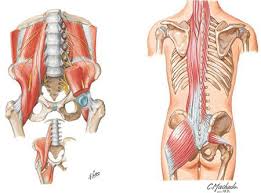
In my book, Move Without Pain, I write that the back lift somatic exercise “addresses all the IMG_3540muscles in  the back of the body that contract in response to activity and ongoing stress.” It’s also called the Landau Response. Whenever you are called into action – the phone rings, you’re in a hurry to go somewhere, you need to do something – all the muscles on the back of the body contract. It’s a joyful, useful reflex.

In the back lift you re-create the green light reflex, so you can DE-create it (and recognize it!) when it happens. This way you don’t get stuck in it. This action of contracting, then slowly lengthening into relaxation, is called “pandiculation” It re-sets muscle function, length and tonus in one easy movement. This is what you’ve seen your cat or dog do when they get up from rest.

Most of us in the industrialized world no longer take the time to relax our muscles after activity, so these muscles learn to stay contracted – even when we’re asleep! Doing the back lift Somatic Exercise brings your brain back into sensory and motor control of the muscles. Once you can begin to FEEL the muscles and how they tighten, then you can RELEASE them.

Below is a video with a tip for how to get the most out of the Back Lift. In my 3-day Somatic Exercise Coach training I teach movement, medical and fitness/athletic professionals how to skillfully teach the Somatic Exercises to their clients so they can move better and do more of whatever activity the practitioner is teaching them. I coach them to be able to see how Sensory Motor Amnesia presents itself within each of the Somatic Exercises. The video below shows one of the ways people unnecessary muscles in order to do this exercise.

For more information about how to train to teach Somatic Exercises skillfully, using the fundamentals of Hanna Somatic Education, go to http://www.essentialsomatics.com.

To buy any of the Essential Somatics instructional DVDs, click here.

Improve Athletic Performance with Somatic Exercise Coaching

Somatics is an excellent adjunct to any training regimen because it supports and enhances a trainer’s work by fundamentally improving an athlete’s own internal awareness and control of his body. The outcome can be an athlete with a range of motion and coordination level he never had or knew he could have.

Today one of the students from the January 2013 Essential Somatic Exercise Coach training in Leeds, England sent me his impressions about the training (that he them posted on a weightlifting forum). He writes:

Here’s a personal view on how this course has been working for me over the past couple of months:

  •  I’ve earned almost all the tuition fees back in a matter of hours.
  •  My physical trainings clients LOVE the results. It’s an easy cross sell, too.
  •  The coaching style is very different and sometimes I feel like I’m making a hash of it compared to imagesMartha’s instruction. But when the client stands up and moves around I can see that I’ve helped them to make a noticeable difference.
  •  I’ve been able to gift my work to a young weightlifter who was all but ready to quit due to chronic pain that wasn’t showing up on any scans (including an MRI).
  •  My personal practice got a big boost.
  •  The other day I was able to use some of the principles to correct an “unpacked” shoulder in the Turkish Get Up very quickly.
  •  I don’t think I’ll ever get used to seeing the clients’ reaction of delight when they stand up to assess themselves after the first session. Helping people feels great.

Never train something you can’t feel.

In athletics, “movement memory” (sometimes called “muscle memory”) is considered the foundation of consistent high performance. This refers to learned physical movements – everything from walking, rolling, crawling, running – to elite athletic performance. The essence of movement memory is the brain’s ability to sense what a movement feels like and to then coordinate muscles to execute that movement at will and with enough precision to meet the demand of the moment.

When muscles become habitually contracted due to an accident, injuries, over-training, improper training, or repetitive tasks, the brain no longer senses them, nor controls them voluntarily. Movement becomes less efficient and less coordinated. This condition is called Sensory Motor Amnesia (SMA). When you train muscles you can’t feel or control, you get hurt, your form is “off” and your playing days could be limited. Don’t despair – this condition is rapidly reversible if you know what to do, what to look for, and how to do it.

Somatics Exercises are Corrective Exercises that prepare you to move better.

Somatic Exercises, which improve your sensory motor system, teach your brain to re-set muscle length, restore optimum muscle function – and eliminate Sensory Motor Amnesia. They are complementary to any Image 19movement discipline – from Yoga, Pilates, NIA and dance, to kettle bells, football, powerlifting, running and cycling.

Somatic Exercises put you back in your body, back in control of the ability to extend, flex, side bend, rotate and twist without limitation, and prepare you to move freely so you can do more of what you want to do. They are what you should be doing before you train every day.

The longer you train, the harder you compete and the higher you strive…the more you need Martha Peterson. Somatics is, without question, the simplest, fastest way to “forget” injuries and overcome training errors. Injured as a Highland Games athlete, I did a lot of thing to fix my hip, and, to be honest, a lot worked. But nothing transformed me more than Martha’s simple techniques. Martha is the “go to girl” for male athletes looking for the pain-free edge.

Dan John, author of Never Let Go

The next Somatic Exercise Coaching Training is coming up – April 19-21 in Leeds, England. Click here for more information and to register early.

Applied Somatics = Pain-Relief (and freedom of movement)

I receive daily emails that say, “I love your DVDs and your book. Hanna Somatics is the only movement method that seems to make any sense. I always thought that my tight muscles had something to do with the way I moved!”

Some emails go on to say, “I do my daily exercises and then the pain comes back about four hours later….what am I doing wrong?”

Here’s what I tell them:

Long term muscle pain relief and improved muscle function come from applying somatic awareness to your daily movement habits.

To quote Thomas Hanna, from the book, Somatics:

The most important thing for you to remember is that Somatic Exercise change your muscular system by changing your central nervous system. If you do not remember this important fact, their effectiveness will be diminished for you.

This says it all. You are literally changing the way in which your brain controls your muscles, movement and even your sense of “self.” Many people “do” their Somatic Exercises, then get up and go about their day without paying attention to several key things in their lives. I ask them:

  • How they WALK – are you heavy on your feet, heel-striking and lumbering from side to side?
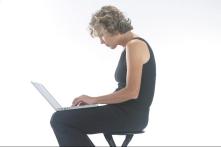
  • How they SIT (at their computer or in the car) – do you sit into one hip? Do you slouch and collapse over your computer (as in the photo at right)? Are you sitting on top of your sit bones, rather than in front or in back of them?
  • How they BREATHE – are you a “breath holder?” Do you allow your belly to relax when you breath?
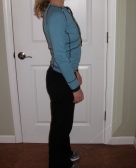
  • How they STAND when you’re not thinking about it – do you sit into one hip? Is your back over-arched (as in the photo below)? Do they stand tall, grounded into their feet?
  • How they RESPOND EMOTIONALLY and how that causes a muscular response in their bodies – do you stop breathing when you’re angry? Do you clench your jaw when you’re upset? Do you hunch your shoulders when you’re fearful?

IMG_1402There is a lot of  learning that takes place when you are on your Somatics mat, eyes closed, brain focused on your internal awareness and movement of your body: Arch and flatten teaches you to sense the gentle movement of the back muscles and relaxation of the belly. The side bend teaches you to contract and lengthen the waist muscles so your hips move more easily. The walking exercises encourage gentle rocking and rolling the pelvis, which helps you regain a balanced gait.

These moments of awareness – things we normally pay no attention to – are opportunities for learning that, when applied to your daily life, create long term, substantive change in your movement once you stand back up into gravity. You are the one who can turn on the light bulb in your own head. As I tell my clinical clients and students who attend my trainings,

The Somatic Exercises, done over time, give you the opportunity to become self-monitoring, self-aware, self-adjusting and self-correcting.

Play the game of awareness.

If move through your daily Somatics routine, feel nice and relaxed, and then get up, rush out the door, and disconnect the physical learning you did on the floor from the way in which you engage with your life, the learning is not translating in your brain and awareness or into your muscles and movement. You are missing the point of the Somatic Exercises and the changes you are seeking to affect will not “stick.”

Try this next time you finish your Somatics routine: get up, and choose to spend the next half a day paying attention to your movement. When you sit in your car take 1 minute and notice how you’re sitting. Before you put your hands on your computer keyboard imagine how you’re going to reach for the keyboard. Make a point to look in the mirror and notice your posture. See it for what it is and then shift yourself if need be.  Before you get up out of your chair, decide how you’re going to do it. Be intentional. And when you’re feeling something emotional, notice how your body is responding as well. Just play the game of awareness and see where it takes you. Let me know how it goes!